Queer Places:
Boston University School, 765 Commonwealth Ave, Boston, MA 02215, United States
Saint John's Cemetery, Parker Rd, Lancaster, MA 01523, United States
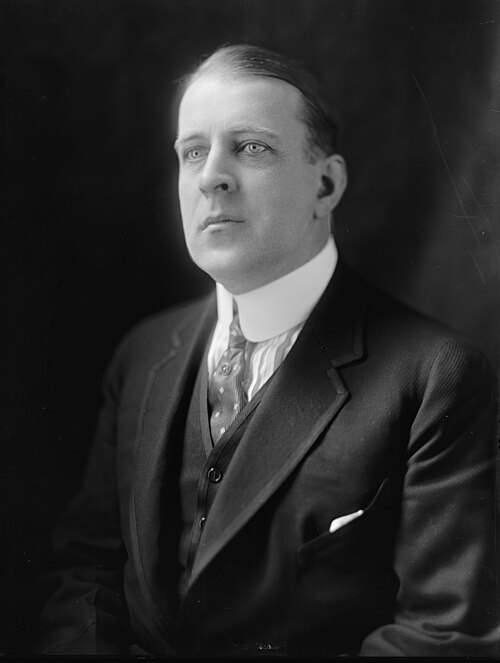 David Ignatius Walsh (November 11, 1872 – June 11, 1947) was born on November 11, 1872, in Leominster, Massachusetts, the ninth of ten children born to
Irish Catholic immigrant parents. After his father, a comb maker, passed away when Walsh was twelve years old, his mother supported the family by running
a boarding house. Walsh graduated from Clinton High School in 1890 and the College of the Holy Cross in 1893 before earning his law degree from the
Boston University School of Law in 1897. He was admitted to the bar and practiced law in Fitchburg and Boston.
David Ignatius Walsh (November 11, 1872 – June 11, 1947) was born on November 11, 1872, in Leominster, Massachusetts, the ninth of ten children born to
Irish Catholic immigrant parents. After his father, a comb maker, passed away when Walsh was twelve years old, his mother supported the family by running
a boarding house. Walsh graduated from Clinton High School in 1890 and the College of the Holy Cross in 1893 before earning his law degree from the
Boston University School of Law in 1897. He was admitted to the bar and practiced law in Fitchburg and Boston.
Walsh entered state politics as a member of the Massachusetts House of Representatives from 1900 to 1901, where he established an anti-imperialist and
isolationist platform. After a period of legal practice, he won election as the state's first Democratic lieutenant governor in seventy years in 1912. In
1914, he achieved another historic milestone by becoming the first Irish Catholic Governor of Massachusetts, serving two one-year terms. As governor, he
championed progressive social welfare reforms, workers compensation improvements, and state care for the insane, while also fighting unsuccessfully for
women's suffrage and pushing for a state constitutional convention.
Transitioning to national politics, Walsh was elected to the United States Senate in 1918 as the first Irish Catholic senator from Massachusetts. A
powerful orator and prominent isolationist, he broke with President Woodrow Wilson to strongly oppose the Treaty of Versailles and the League of Nations,
earning a place among the congressional "Irreconcilables." Although he lost his seat in the 1924 Coolidge landslide, he returned to the Senate in a 1926
special election and subsequently won re-election in 1928, 1934, and 1940. During the New Deal era, he frequently clashed with President Franklin D.
Roosevelt, opposing the court-packing plan and leading the America First Committee as a vocal opponent of American entry into World War II. Despite his
skepticism of Roosevelt's foreign policies, he sponsored the massive Vinson-Walsh Naval Expansion Act and authored the Walsh-Healey Public Contracts Act,
which established crucial labor standards and minimum wages for government contractors. Later in his career, his foreign policy views evolved
sufficiently for him to vote in favor of the United Nations Charter in 1945.
Throughout his public life, Walsh never married and lived with the quiet reality of his private sexuality, which intersected with a turbulent
political climate. Rumors about his romantic life circulated within political and gay circles for decades, and future literary figures like
Gore Vidal later recounted tales of the Senator's encounters in Boston. These underlying whispers culminated in a
major political and espionage crisis in May 1942, when the New York Post published sensationalized allegations implicating Walsh in a scandal surrounding
a Brooklyn club patronized by servicemen and civilian men. Although an FBI investigation ordered by J. Edgar Hoover cleared Walsh of any connection to
enemy agents or treasonous activity, and Senate Majority Leader Alben Barkley delivered a fierce defense exonerating his reputation on the Senate floor,
the severe stigma surrounding homosexuality at the time left permanent political scars.
Following the scandal, Walsh continued his Senate service until he was defeated for re-election in 1946 by Henry Cabot Lodge Jr., bringing a close to
his decades-long career. He passed away shortly thereafter on June 11, 1947, in Boston, Massachusetts, and was laid to rest at Saint John's Cemetery in
Lancaster, Massachusetts. Modern historians and biographers have recognized that the covert campaigns and accusations targeting his personal life
severely impacted his final years, cementing his legacy as a complex, maverick statesman whose historic achievements as a trailblazing Irish Catholic
leader were shadowed by the prejudices of his era.
References:
Other references:
- Wayman, Dorothy G. David Walsh: Citizen-Patriot. Milwaukee: Bruce Publishing Co., 1952. (The primary full-length historical biography written on Walsh, utilizing personal and congressional records).
- Grattan, William Joseph. "David I. Walsh and His Associates: A Study in Political Theory." Ph.D. dissertation, Harvard University, 1958.
- Kirchick, James. "How World War II Led to Washington's First Outing: A wild tale of Nazi spies, a Brooklyn brothel and the private life of a senator." Published in The Washington Post Magazine, June 15, 2022. (Detailed modern deep-dive into the 1942 Brooklyn raid, Gustave Beekman, and the political/media scandal surrounding Walsh's private life).
- Flannagan, John H., Jr. "The Disillusionment of a Progressive: U.S. Senator David I. Walsh and the League of Nations Issue, 1918-1920." The New England Quarterly 41, no. 4 (December 1968): 483–504.
- Kenneally, James J. "Catholicism and Woman Suffrage in Massachusetts." Catholic Historical Review 53 (1967): 54–55. (Covers Walsh’s political engagements with social reform and progressive alignments as governor).
- Rogers, Alan. "Chinese and the Campaign to Abolish Capital Punishment in Massachusetts." Journal of American Ethnic History 18 (1999): 55–56. (Examines Walsh's alignment with penal and humanitarian reforms during his state administration).
- Loring, Augustus Peabody. "A Short Account of the Massachusetts Constitutional Convention of 1917–1919." The New England Quarterly 6 (1933): 89–14. (Documents Walsh's role as a delegate-at-large championing Progressive-era initiatives and referendums).
- College of the Holy Cross (Worcester, MA): David I. Walsh Papers, 1890–1946. (Contains roughly 30 feet of personal correspondence, scrapbooks, press releases, photographs, and speeches documenting his professional trajectory).
- Library of Congress (Manuscript Division, Washington, DC): Dorothy Wayman Papers, 1862–1971. (Includes foundational research materials and collected biographical notes compiled for the David Walsh: Citizen-Patriot manuscript).
- United States Congress Historical Office: Biographical Directory of the United States Congress – David Ignatius Walsh (1872–1947). Official legislative service details spanning his governorship and multi-term senate career from 1919 to 1947.
- National Governors Association (NGA): Historical Governors Dossier – Gov. David Ignatius Walsh. Summary of executive metrics, legislative actions, and milestones as Massachusetts' 46th governor.
Support this project
This website is a passion project researched, developed, and funded entirely by me. If you find the content valuable and would like to help support the ongoing research and hosting costs, any contribution is deeply appreciated.
Thank you for keeping this independent resource alive!
My books on Amazon: Elisa Rolle's books
BACK TO HOME PAGE